7 November 2026 · Temple Admin
Inside the Garbhgrah of Kesariyaji: The Moolnayak, the Ashtadhatu Parikar and the Navgrah
A detailed look inside the Garbhgrah of Kesariyaji: the black stone Moolnayak of Bhagwan Rishabhdev, the Ashtadhatu parikar, the sixteen dreams, the Navgrah row, and what the evidence says about the Digambar identity of the image.
हिंदी में पढ़ें: केसरियाजी का गर्भगृह
Every devotee who comes to Kesariyaji walks through ten steps, the Nau Chowki and the Khela Mandap for one reason, to stand for few moments before a small silver lined room. Inside it sits the black stone image of Bhagwan Rishabhdev that gave this tirth its name. Most visitors see it through kesar and flowers and go home without knowing what they saw.
This post walks through the Garbhgrah piece by piece: the Moolnayak, the Ashtadhatu parikar, the simhasan with its sixteen dreams, and the row of small figures in front that people call Navgrah. Then it shows how this Digambar image has been altered over time, and why every part of the sanctum proves that Kesariyaji is a Digambar tirth. Every fact carries its source and the full list is at the end.
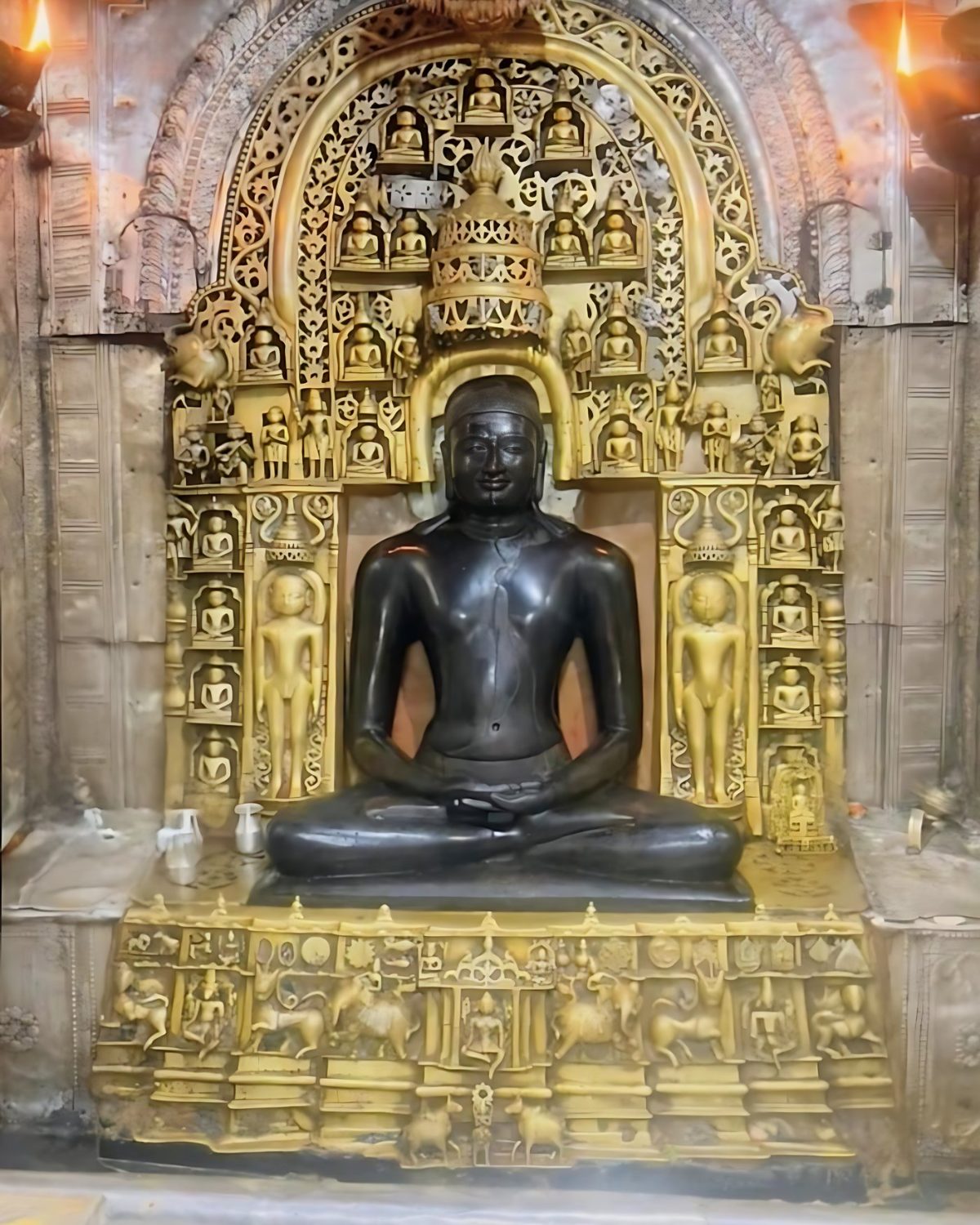
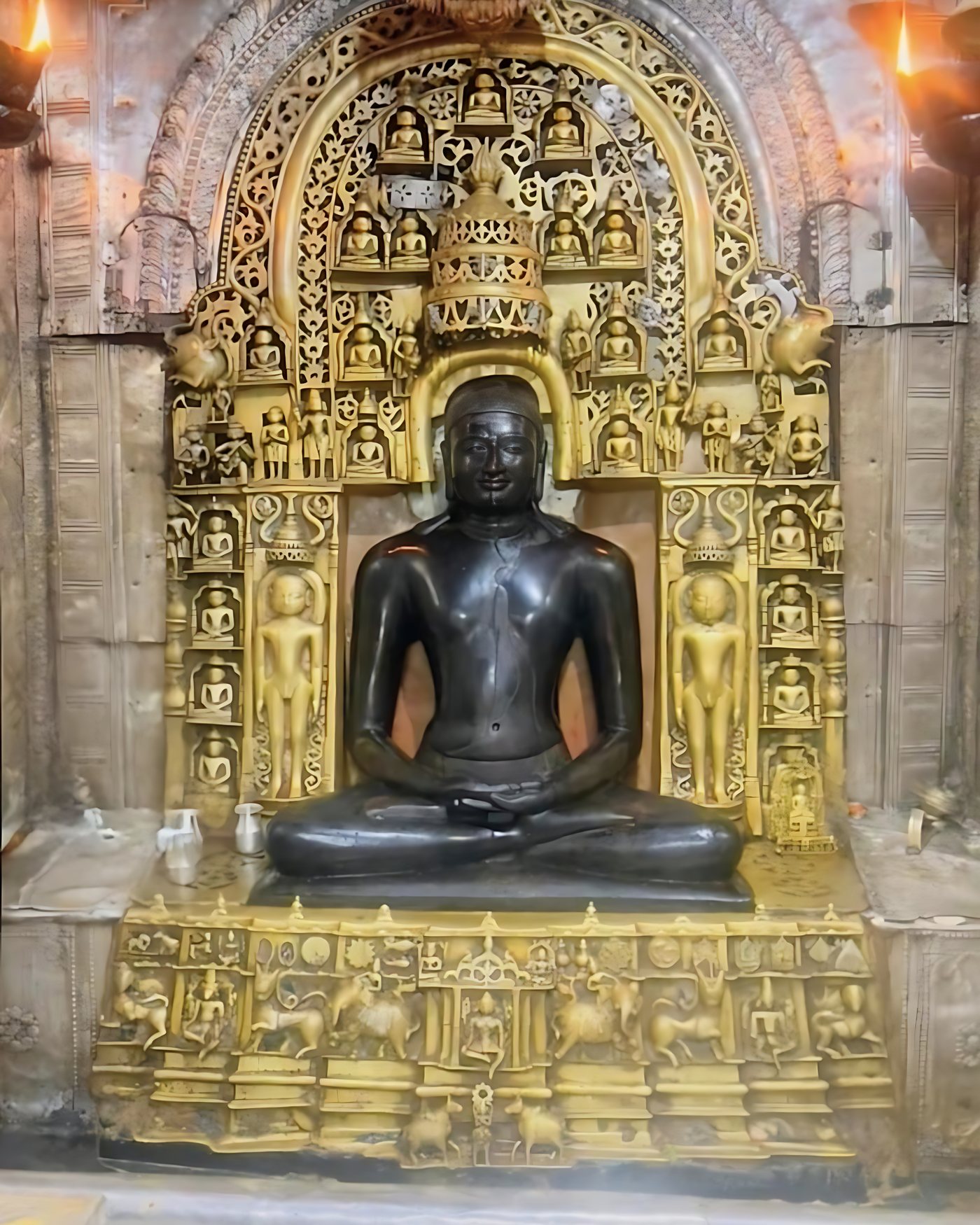
The Garbhgrah today. The photograph has been digitally enhanced, so it is used here for the general view only.
The Garbhgrah at a glance
Moolnayak: Bhagwan Rishabhdev, first Tirthankar
Stone: black (shyam varna) stone
Posture: Padmasana, dhyan mudra
Height: about 3.5 feet (Brief, p. 2; TV, p. 6). One article gives 108 cm (PTJ, p. 72).
Above the head: three chhatra (Brief, p. 2; PTJ, pp. 3, 29)
Parikar: Ashtadhatu according to the Brief, with 23 small Jina images (Brief, p. 2; TV, p. 6)
Simhasan: sixteen dreams, Yaksha and Yakshi, two bulls (Brief, pp. 2, 3; TV, pp. 6, 7)
Inscription on the image: none (PTJ, p. 29; TV, p. 7)
Age: about 12th century on style, with older dates also proposed (TV, p. 7; PTJ, pp. 3, 72)
The Garbhgrah room
The sanctum is very small (TV, p. 6). You reach it at the end of a line that runs through the whole temple: from the outer gate up ten steps, through the Nau Chowki, and through the Khela Mandap (Brief, p. 3; PTJ, p. 17). The Khela Mandap has two old inscriptions, facing each other, and the door of the sanctum opens from it.
Except for the simhasan, the Garbhgrah and its door are covered in silver (PTJ, p. 30). A visitor's account of 2004 describes three walls lined with silver, and doors and frame covered with thick silver sheet (PTJ, p. 72). Over the room rises a large shikhar in the Rekha Nagara style (TV, p. 6), with the dhwajadand above it. Four more tall shikhars stand on the four sides (TV, p. 6).
The building is planned so that the rising sun reaches the feet of the Moolnayak, and so that darshan is possible even from outside the first gate, down the whole line of doors (PTJ, p. 28). Anyone who has stood at the lower gate at sunrise will know this view.
The oldest dated record for this room is the inscription of Samvat 1431 (1374 CE) in the Khela Mandap. It says the Rishabheshwar prasad was renovated on the teaching of Bhattarak Dharmakirti, by Sah Hardas, his wife Haru and sons Punja and Kota (TV, pp. 17, 18; PTJ, pp. 26, 33; Nagori, p. 7). Dharmakirti belonged to the Digambar Kashtha Sangh. The same stone opens with the first verse of the Digambar Laghu Swayambhu Stotra (Brief, p. 4). Since a renovation needs an older building, the Garbhgrah is older than 1374 CE.
The Moolnayak pratima
The image is seated in Padmasana with hands resting in the lap, carved from black stone. The body is plain and unclothed, without any ornament cut into it. Tirth Vandana's survey report calls it fully nude in Digambar tradition (TV, p. 6). Hair locks falling on the shoulders identify it as Rishabhnath, and the bull lanchhan on the simhasan confirms this (TV, p. 6). The locks are partly worn away with age (PTJ, p. 29).
Because of the dark stone the Bhil community calls Him Kalaji and Kariya Baba. Others call Him Dhuleva Dhani and Kesariyalal (TV, p. 5; PTJ, p. 30). So much kesar is offered that the name Kesariyaji stayed (Brief, p. 2).
How old is the image?
There is no inscription on it, so its age can only be estimated. The survey by Dr Navneet Kumar Jain places it about the 12th century by style (TV, p. 7). Prof. Bhagchandra Jain Bhaskar suggests about the 10th century (PTJ, p. 3). Another article says 8th century (PTJ, p. 72). Older traditions speak of a brick temple in the 2nd century and a stone temple in the 8th (Brief, p. 4; PTJ, p. 26), but no inscription backs these. Whichever date is taken, the oldest record of this sanctum is a Digambar record.
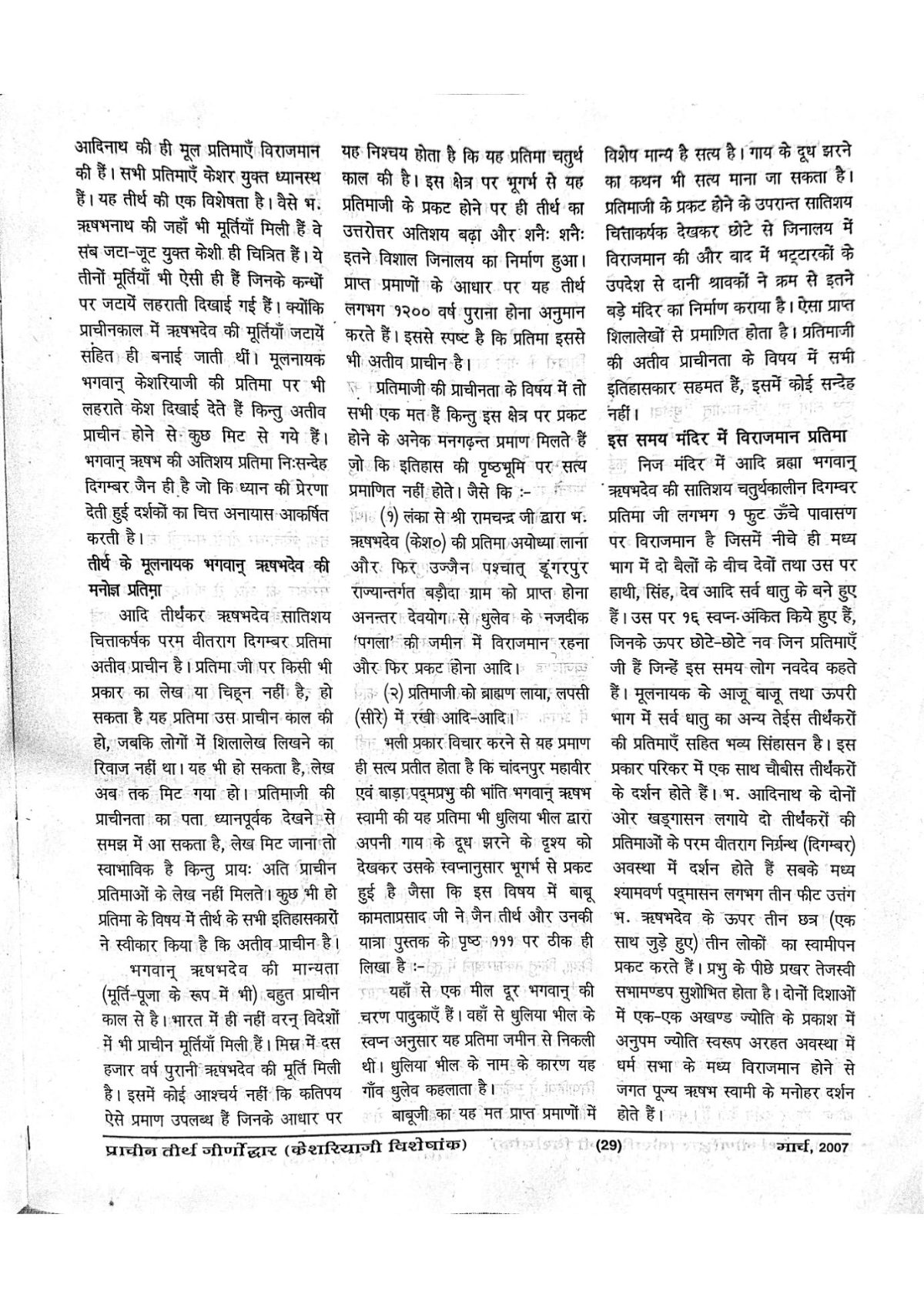
PTJ, p. 29. The description of the Moolnayak, the sixteen dreams and the nine small images.
The Ashtadhatu parikar
Behind the image stands the metal parikar, one of the most beautiful pieces of work in the tirth. The Brief calls it Ashtadhatu (Brief, p. 2). The survey only says metal (TV, p. 6), and one visitor calls it a golden pithika (PTJ, p. 72). Its parts are as follows.
23 small Jina images. Two stand in Kayotsarga on either side of the Moolnayak, and 21 are in Padmasana (Brief, p. 2; TV, p. 6). With the Moolnayak they make a full Chaubisi of 24 Tirthankars.
Parshvanath and Suparshvanath. Two of the small images can be identified by their hoods, seven for Parshvanath at the lowest niche on the left of the Moolnayak, and five for Suparshvanath to the right of His head (TV, p. 6).
The two standing Jinas. They are nude and in dhyan (PTJ, p. 6; Nagori, p. 11). Ojha, a Brahmin historian with no side in this dispute, recorded them in his history.
Musicians. On both sides of the head are four musicians each, playing mangal vadya (Brief, p. 2).
Devas with kalash. Above the head devas are shown doing abhishek (Brief, p. 2).
Ashta Pratiharya. The survey notes these in the Digambar manner (TV, p. 6).
Three chhatra. They stand for lordship of the three loks (PTJ, p. 29).
All the small images of the parikar are nude and of the Digambar amnaya, and this form of parikar belongs to Digambar tradition (TV, p. 6). The parikar alone is enough to show whose sanctum this is.
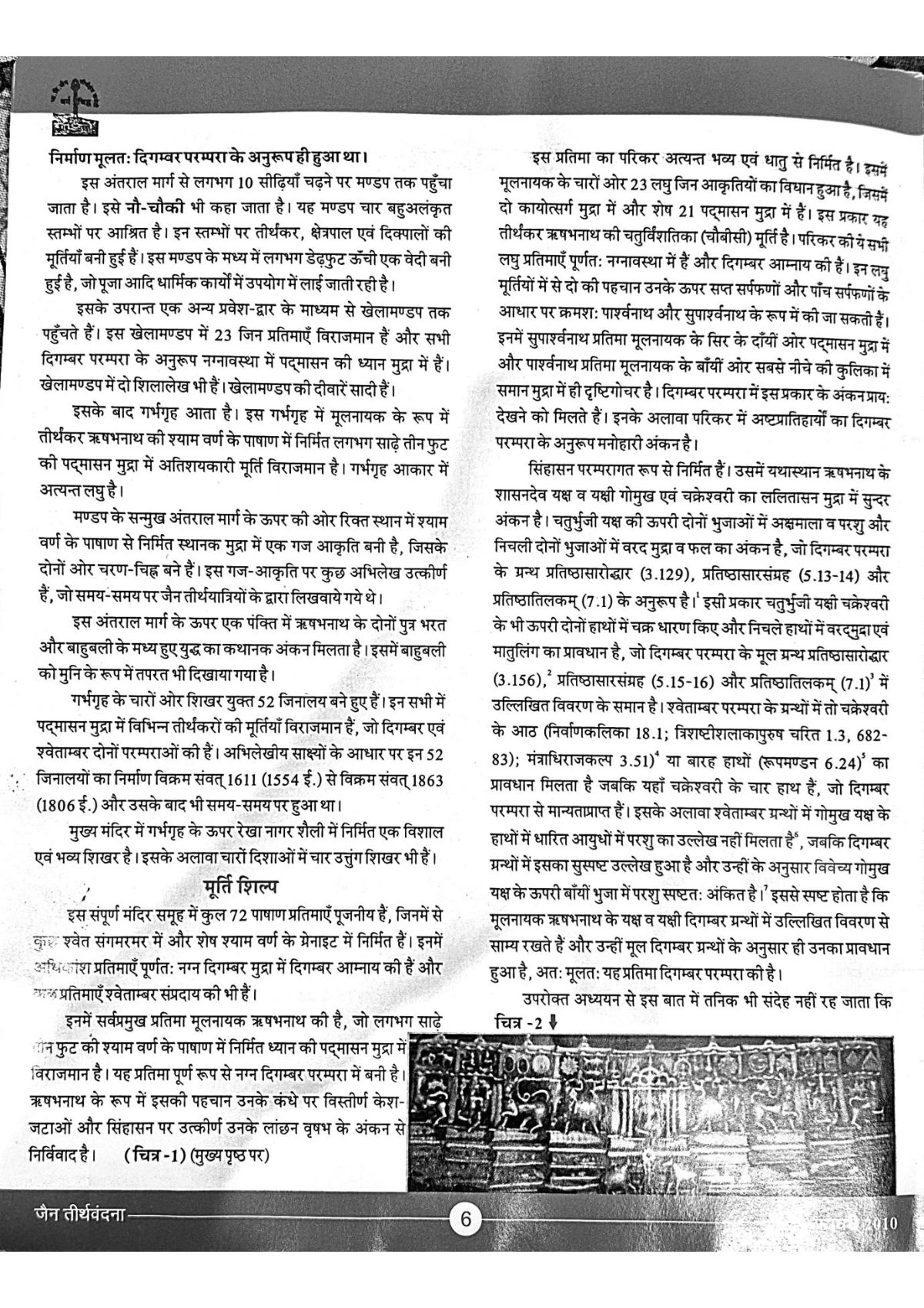
TV, p. 6. The survey report on the parikar and the Yaksha and Yakshi.
The simhasan and the sixteen dreams
The simhasan is the part of the Garbhgrah that speaks loudest. It has rows of metal relief, and each small panel has a meaning.
Top row: sixteen dreams
At the centre sit Mata Marudevi and Raja Nabhiray. She tells him the dreams she saw in the last part of the night and listens to their meaning (Brief, p. 2). On both sides are the dreams. Digambar tradition counts sixteen, listed in the Mahapurana (12.101 to 119) and Harivansh Purana (8.58 to 74). Shwetambar tradition counts fourteen, following the Kalpasutra (TV, p. 7).
The sixteen are: elephant, bull, lion, Lakshmi, two garlands, moon, sun, two fishes, two kalash, lake, ocean, throne, deva vimana, nagendra bhavan, heap of jewels and smokeless fire (TV, p. 7). Ojha noted the same count (PTJ, p. 9), and Nagori's reply pointed out that a Shwetambar image would show fourteen (Nagori, p. 11).
Lower row: ten figures
Reading from the two ends, the first and last are lions. Second and eighth are Gomukh Yaksha and Chakreshwari Yakshi. Third and seventh are lions again, as a sign of the strength of Jin shasan. Fourth and sixth are Airavat elephants, which is why the seat is also called Gajapith. At the centre sits Shachi Indrani in lalitasana, an ankush in her hand, because she first brought the newborn Bhagwan out of the birth chamber for the world to see (Brief, pp. 2, 3).
Lowest panel: two bulls
At the very bottom are two bulls, the lanchhan of Rishabhdev. Between them stands Sarvahna Yaksha carrying a dharmachakra on his head (Brief, p. 3).
Why Gomukh and Chakreshwari matter
This is the strongest iconographic point in the survey. Gomukh here holds a parashu in his upper left hand, as the Digambar texts Pratishthasarasangraha (5.13, 14), Pratishthasaroddhara (3.129) and Pratishthatilakam (7.1) prescribe. The Shwetambar lists of his weapons do not include a parashu (TV, pp. 6, 21, 22). Chakreshwari here has four arms, which is the Digambar form. The Shwetambar texts give her eight or twelve (TV, p. 6).
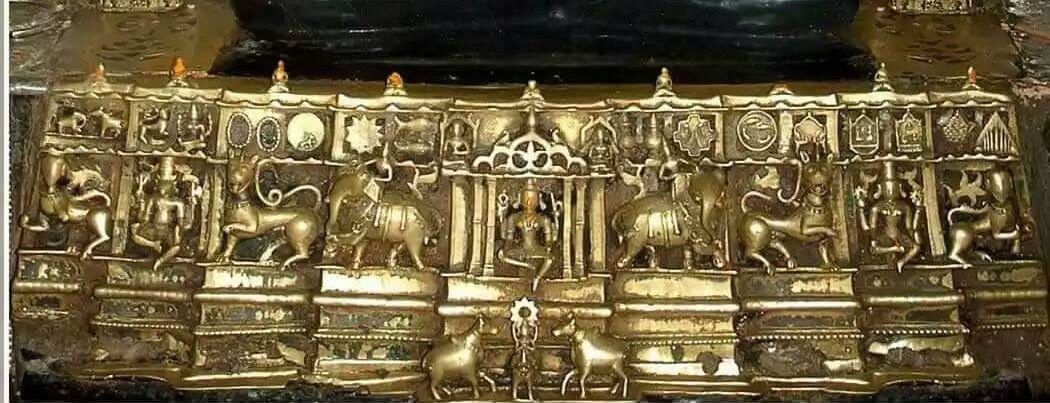
The simhasan in an old photograph. Top row, the sixteen dreams. Then the lions, Airavat, Gomukh and Chakreshwari, with Shachi in the centre, and the two bulls at the bottom.
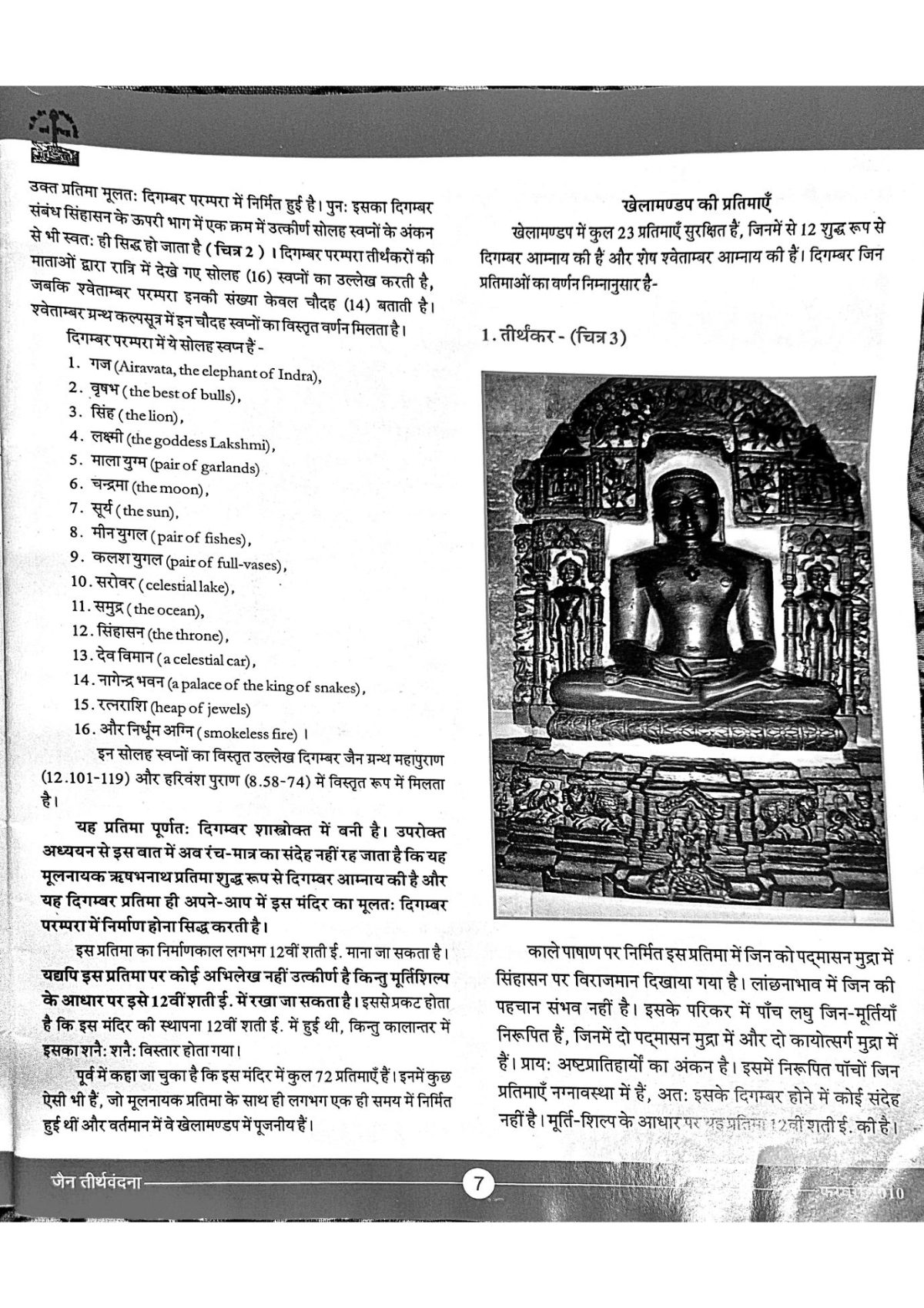
TV, p. 7. The list of sixteen dreams, with the conclusion of the survey.
The Navgrah row in front of the Moolnayak
Along the top edge of the simhasan, directly in front of the Moolnayak, stand nine very small figures. The sources do not agree on their name. Ojha wrote that people call them Navnath or Navgrah (PTJ, p. 6). PTJ describes nine small Jina images that people now call Navdev (PTJ, p. 29), and the editor uses Navdevata (PTJ, p. 3). They are placed above the row of sixteen dreams.
Some of these nine are broken today. The photographs show them worn, and at least one is little more than a stump. A row of sacred figures placed directly before the Moolnayak of a great tirth should not be left in this state. These nine must be properly examined, recorded and protected.
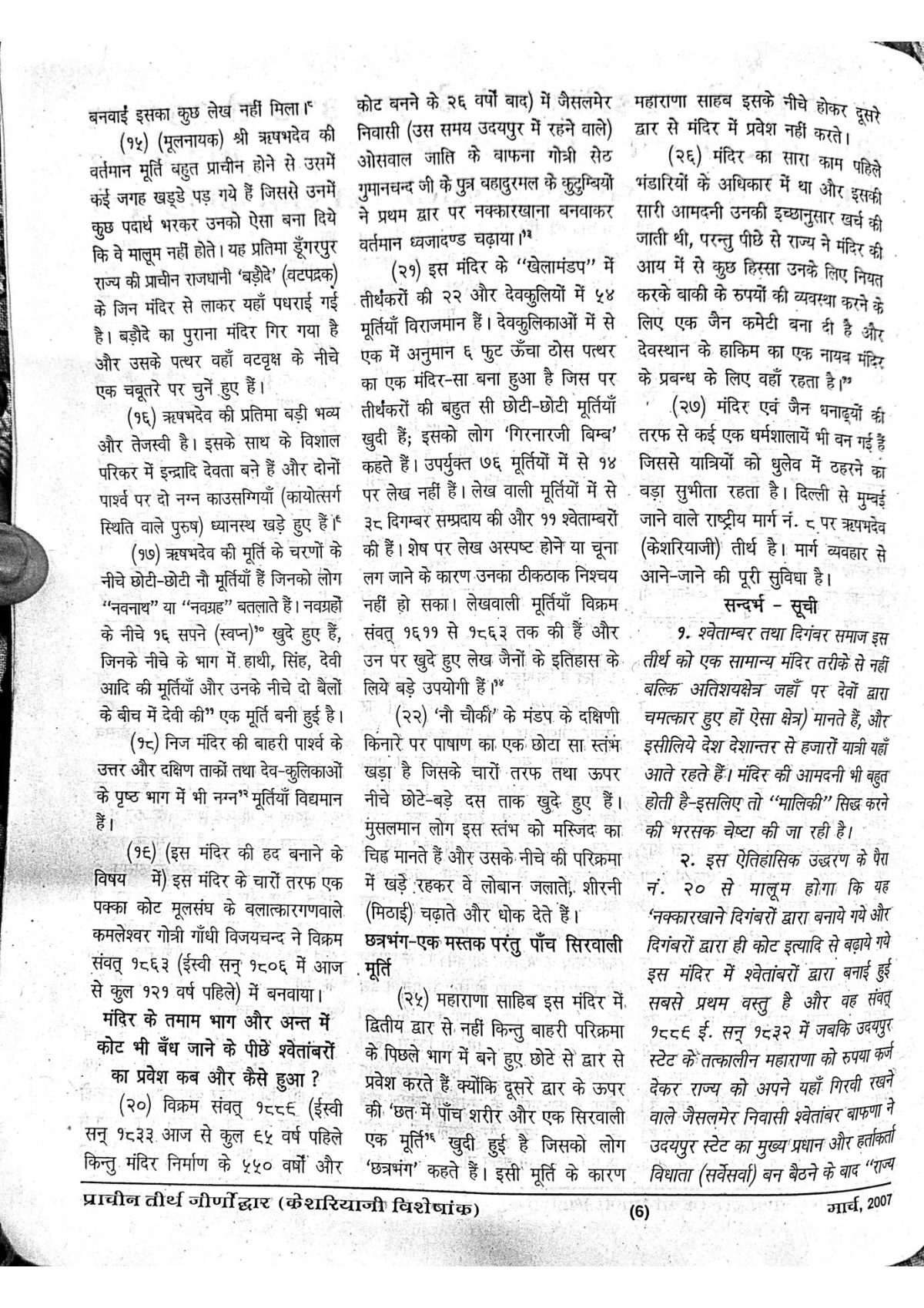
PTJ, p. 6. Ojha's notes on the image, including the filled pits (para 15), the nude Kayotsarg figures (para 16) and the nine small images (para 17).
Nasagra Drishti and the lepan
Digambar granths describe the gaze of a Tirthankar pratima as Nasagra Drishti, resting on the tip of the nose, because the soul has turned fully inward. The Moolnayak of Kesariyaji had this Nasagra Drishti. It has been smoothed away during the lepan process, and the face we see today no longer shows it as it was.
The written record shows how the surface of this image has been worked on:
Ojha wrote that the image is so old that pits formed in many places, and these were filled with some substance so that they cannot be noticed (PTJ, p. 6). So the surface we see today is not all original stone.
The image has no glass eyes. Wadilal Motilal Shah noted that it is without chakshu and without langot (PTJ, pp. 8, 9). Lakshmisahay Mathur also wrote that the eyes are not separate pieces but part of the image in the same dark colour (Nagori, pp. 10, 11).
A Shwetambar image, as Shah explains, has a hollow cut around the eye for a shining glass eye (PTJ, p. 9). The Moolnayak has nothing of this kind.
This is a Digambar face, made in the Digambar way, and lepan cannot change what it was.
The kandora and janeu lines
A Digambar image has nothing on the body. Shah set out the difference plainly: a Digambar image has no crown, no kundal, no ornament, and not even a langot mark, while on a Shwetambar image a langot is carved and ornaments are added (PTJ, p. 9). This is why a line at the waist or across the chest is not a small matter. A waist line makes the body look as if it wears a kandora, and a chest line makes it look as if it wears a janeu.
The old photograph below answers the question. There is no kandora line at the waist and no janeu line from the shoulder. The body is plain, in pure Digambar form. Compare it with the image today.
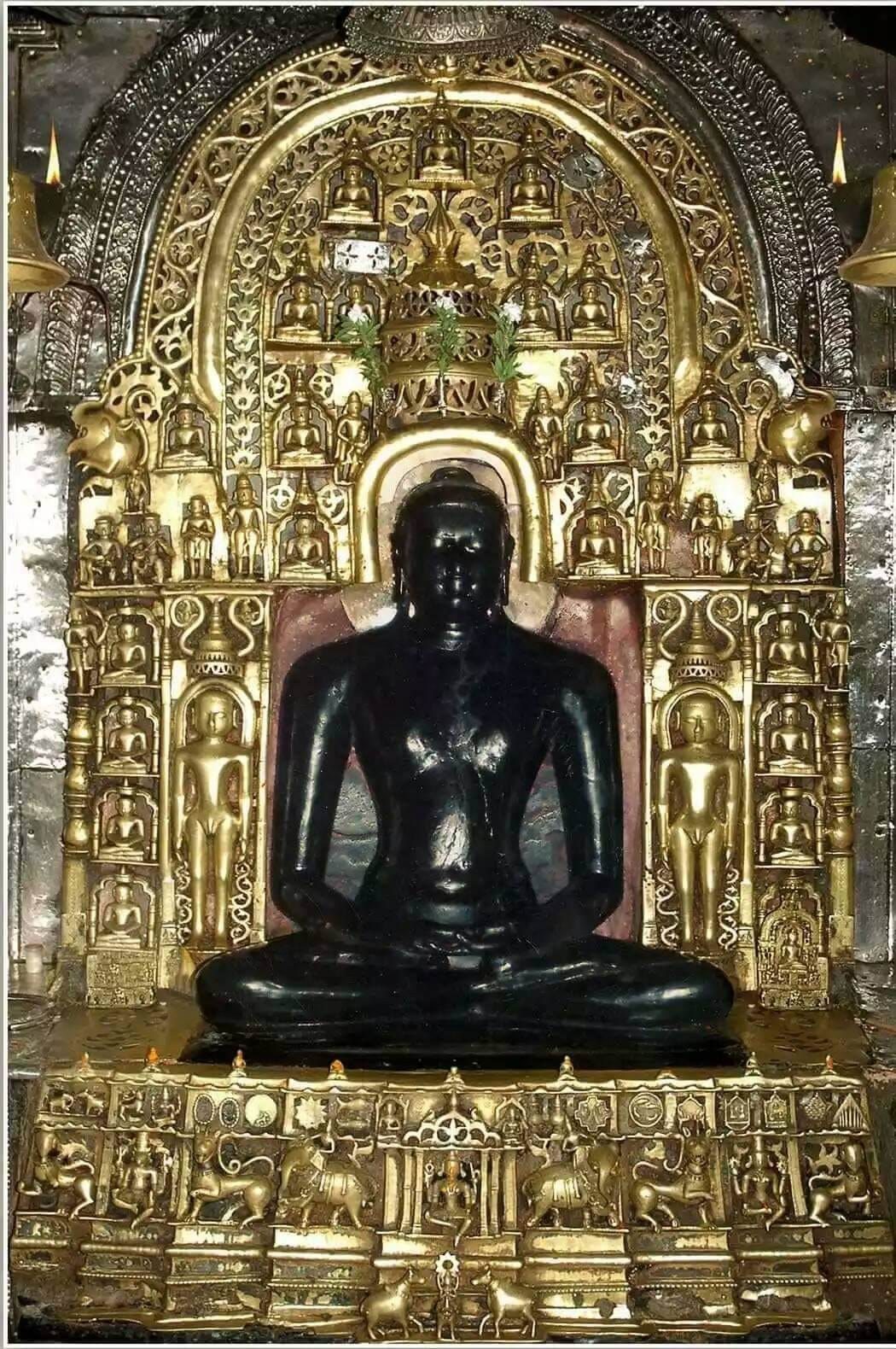
Old photograph of the Moolnayak. No kandora and no janeu.
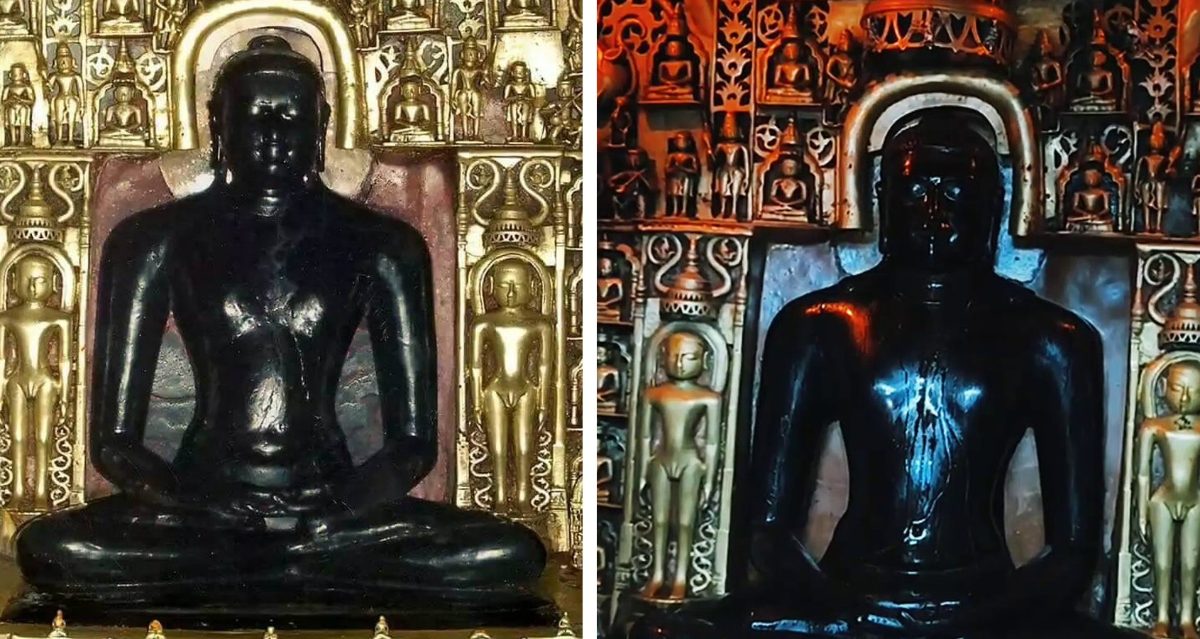
Left, the old photograph. Right, a frame from a recent video.
Our position is clear. These lines were not part of the original image. In our view they were added later and intentionally, by other communities who wanted to weaken the Digambar identity of this image and build a claim on the temple. The record shows that this image and this temple have been a target again and again:
Mukut and kundal were put on Digambar images by force in 1927, and six people died in that dispute. Shah noted that the Moolnayak stayed without langot and chakshu even after that (PTJ, p. 9).
A hira aangi was made for the Moolnayak. Digambars opposed it being made from temple funds, so the Maharana paid for it privately (TV, pp. 34, 35; Nagori, p. 53).
A parwana of Samvat 1889 shows that till then ornaments put on the image used to be broken (Nagori, p. 51, note). Even in that period the image was not meant to wear ornaments.
A chabutra used by Digambar bhattaraks for shastra reading was changed in a single night, on the excuse of repairs, and Shrimad Bhagwat was written on it (PTJ, pp. 17, 27; Brief, p. 7). A change made quietly at night shows how such things were done in this temple.
The word janeu itself appears in the old dispute, when it was said that a janeu was put on Bhagwan (Nagori, p. 5). The body of the Lord was being fought over.
Evening aangi still continues today (PTJ, pp. 20, 32), although Digambar daily puja does not dress an image after Panch Kalyanak (TV, p. 34).
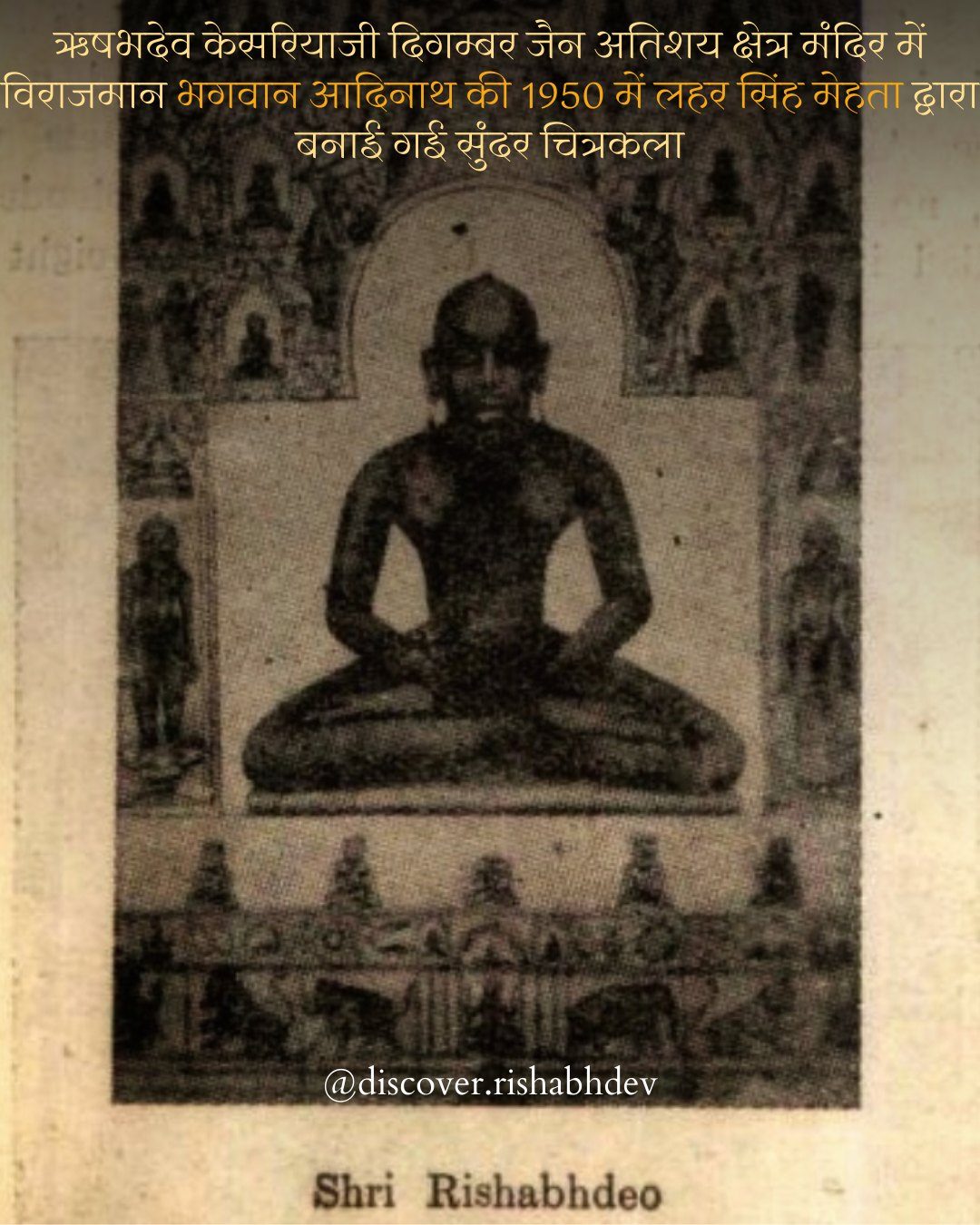
A painting of the Moolnayak, made in 1950 by Lahar Singh Mehta.
Why the Garbhgrah is Digambar
The image. Fully nude, no langot, no glass eyes, no ornament cut in stone (TV, p. 6; PTJ, pp. 8, 9).
The dreams. Sixteen, not fourteen (TV, p. 7).
Yaksha and Yakshi. Made according to Digambar texts (TV, pp. 6, 21, 22).
The parikar. 23 nude Jina images (TV, p. 6).
The door above. Chakreshwari and Digambar Padmasana Jinas on the lintel of the antaral (TV, p. 5).
The sanctum record. Renovated in 1374 CE by a Digambar bhattarak's teaching (TV, pp. 17, 18).
The outer walls. Nude Digambar images on the walls around it (TV, pp. 16, 17; PTJ, p. 6).
Other inscriptions. Bhattarak records from Samvat 1431 to 1863 (Nagori, p. 13; TV, pp. 16 to 21).
Bhattarak gaddis. Mulsangh on the north side and Kashtha Sangh on the south side (PTJ, pp. 17, 28; Brief, pp. 6, 7).
Shah showed that the earliest Shwetambar connection with this temple is only of Samvat 1889, when the Bafna family, then in power in the state, built the Nakkarkhana and raised a dhwajadand (PTJ, pp. 6, 7). That is more than four hundred years after the Digambar renovation of 1374 CE. Ojha's count of the images in the Khela Mandap and devkulikas lists 38 Digambar against only 11 Shwetambar among those with readable inscriptions (PTJ, p. 6; Nagori, p. 12). Those Shwetambar images are later, not before the 17th century, and were put in during a period of change (TV, pp. 12, 21). The original structure of the temple has not one Shwetambar image in it (TV, p. 21).
Prof. Bhagchandra Jain Bhaskar put it directly: the Shwetambar tradition has no connection with this tirth in the pages of literature, history or art (PTJ, p. 4). The survey ends with the same verdict: this is undisputedly a Digambar temple (TV, p. 21).
What the courts have said
People who deny the Digambar identity of Kesariyaji usually quote one line, that the Rajasthan High Court in 1966 called it a Shwetambar temple (PTJ, p. 75). That is not the final word. The Supreme Court held it to be a Jain temple and not a Hindu temple. In its judgment of 4 January 2007 it wrote plainly that the question whether the temple is Swetambars' or Digambars' did not fall for its consideration (PTJ, pp. 75, 81). So the Supreme Court has not declared this a Shwetambar temple. Digambars have filed their own petition to have it declared a Digambar Jain temple (PTJ, p. 76), and Mewar's own Dhwajadand Commission said that the temple was a Digambar temple from the beginning (PTJ, p. 19; Brief, p. 9).
A court order about who manages a temple cannot change what is carved in its sanctum.
Conclusion
Stand in front of the Moolnayak and read what is actually there. A bare body in dhyan with no ornament cut on it. Two nude Jinas beside it. Twenty one more above. Sixteen dreams under the seat. A Gomukh with a parashu and a Chakreshwari with four arms. A sanctum renovated on the teaching of a Digambar bhattarak, in a temple built and extended by Digambar shravaks for centuries.
The conclusion is firm. The Moolnayak is Digambar. The Garbhgrah is Digambar. The temple is Digambar. It cannot be Shwetambar, because every mark of a Shwetambar image is missing here and every mark of a Digambar image is present. The lines, the lepan, the aangi and the ornaments came later. The stone came first, and the stone is Digambar.
Jains of both traditions, Bhils, Vaishnavas and Shaivas have all come here in devotion (PTJ, pp. 5, 31), and they are welcome. But devotion of others does not make the temple theirs.
When you next come for darshan, please look slowly. Look at the sixteen dreams, the two standing Jinas and the nine small figures in front of the Lord. They have been telling this history for centuries, and it is a Digambar history.
For the wider history see Is Kesariyaji a Digambar or Shwetambar Temple? and Bhattarak Parampara and Kesariyaji.
Sources
Brief: Shri Rishabhdev Mandir evam Iski Parampara, Sankshipt Itihas, booklet, pp. 2 to 13.
TV: Jain Tirth Vandana, year 5, issue 2, February 2010, mouthpiece of Bharatvarshiya Digambar Jain Tirthkshetra Committee. Includes Dr Navneet Kumar Jain, Puratattvik Sarvekshan Prativedan (pp. 5 to 30), and Shantilal Jain Jangda on puja paddhati (pp. 31 to 35).
PTJ: Prachin Tirth Jirnoddhar, Kesariyaji Visheshank, March 2007. Includes the editorial of Prof. Bhagchandra Jain Bhaskar, Wadilal Motilal Shah's notes on Pt. Gaurishankar Hirachand Ojha's Rajputane ka Itihas (pp. 5 to 11), Gyanmal Shah (pp. 25 to 35), and Dr Prakashchand Jain (p. 72), with the Supreme Court judgment of 4 January 2007 (pp. 75 to 81).
Nagori: Nagoriji Rachit Kesariyaji ke Itihas par ek Drishti, foreword by Lakshmisahay Mathur, Samvat 1991.
Page numbers are the printed numbers.