2 August 2026 · Temple Admin
Bhattarak Parampara and Kesariyaji - Who actually built and looked after Rishabhdev tirth for five hundred years
If you've visited Kesariyaji, you've already seen the legacy of the Bhattaraks perhaps without realizing it. The shikhar, Khela Mandap, Nauchowki, Bawan Jinalays, Sahastrakut Jinalay, and the parkota all bear inscriptions dating from Vikram Samvat 1431 to 1863. These stone records repeatedly mention Digambar Jain Bhattaraks, whose contributions shaped the temple for nearly 500 years.
If you have been to Kesariyaji even once, you have already seen the work of the Bhattaraks. Most people just do not know it.
Look at the shikhar above the garbhagriha. Look at Khela Mandap, at the Nauchowki, at the bawan jinalays going all around, at the Sahastrakut Jinalay with its 1008 pratimas. Look at the big parkota outside. Almost every one of these has a stone lekh attached to it, and almost every lekh gives you a date and a name. The dates start from Vikram Samvat 1431 and go till Samvat 1863. That is close to five hundred years of continuous work. And the names that keep coming again and again are Dharmakirti, Yashkirti, Bhimsen, Surendrakirti, Nemichandra, Chandrakirti.
All of them Digambar Jain Bhattaraks.
So if you want to understand the history of Kesariyaji properly, first you have to understand what a Bhattarak actually was.
Who was a Bhattarak?
A Bhattarak is head of a Digambar Jain gaddi or pith. The word in Sanskrit means something like venerable one, respected one. It was a title of honour, given to a learned dikshit person who looked after the religious matters of a whole region.
Now a question comes here which many people ask, and it is a fair question. The real ideal of Digambar tradition is the nirgranth muni. No clothes, no possession, no fixed place to stay, no worldly responsibility. So how did a parampara of saffron robed heads of seat come into the picture?
The answer is practical, not doctrinal. That ideal never changed, and it never will. But think once. A digambar muni cannot hold the property of a mandir. He cannot go and argue a case in the darbar of a raja. He cannot run a shastra bhandar, cannot accept a land grant, cannot appoint a pujari, cannot sign anything. And in the medieval period, with political disturbance everywhere, with attacks on temples, with jain rajashray finishing one by one, somebody had to do exactly these things. Somebody had to stand in front of the ruler and say, this mandir is ours.
Bhattarak was that person. He took a middle position between the full muni and the shravak. Bhagwa vastra in place of nagnata. A fixed gaddi in place of constant vihar. Administration in place of pure nivritti. He was dikshit, brahmachari, learned, bound by vrats. But he was visible in society in a way a digambar muni simply could not be. The chhatra, the chanwar, the palki that we see around a Bhattarak, all this was not luxury. These was the working equipment of a public office.
The institution took proper shape from around the 12th and 13th century onwards and it dominated Digambar religious life till the 19th century. At its peak the gaddis were spread all over. Delhi, Jaipur, Nagaur, Ajmer, Idar, Surat, Sagwara, Dungarpur, Karanja, Kolhapur, Humcha, Shravanbelgola.
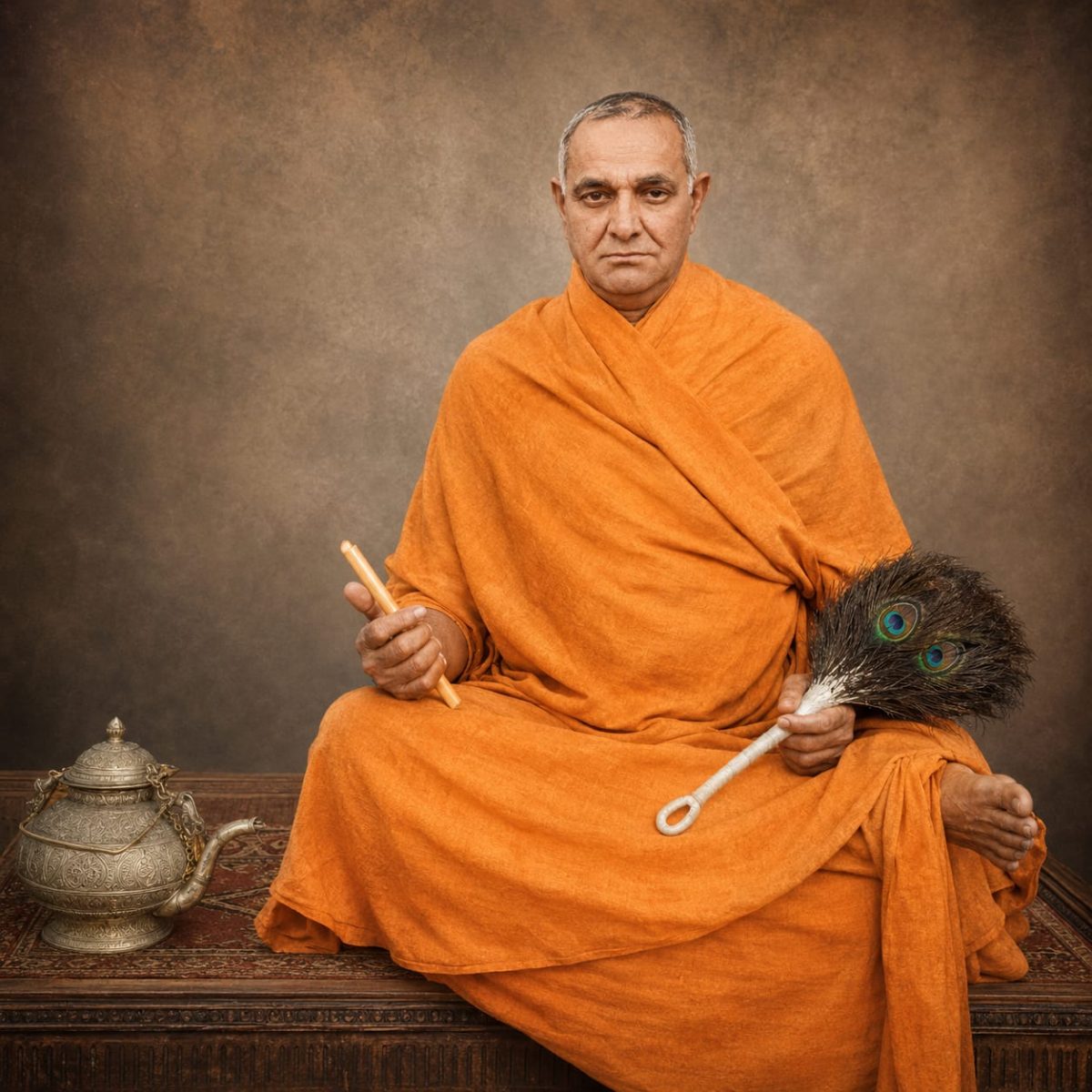
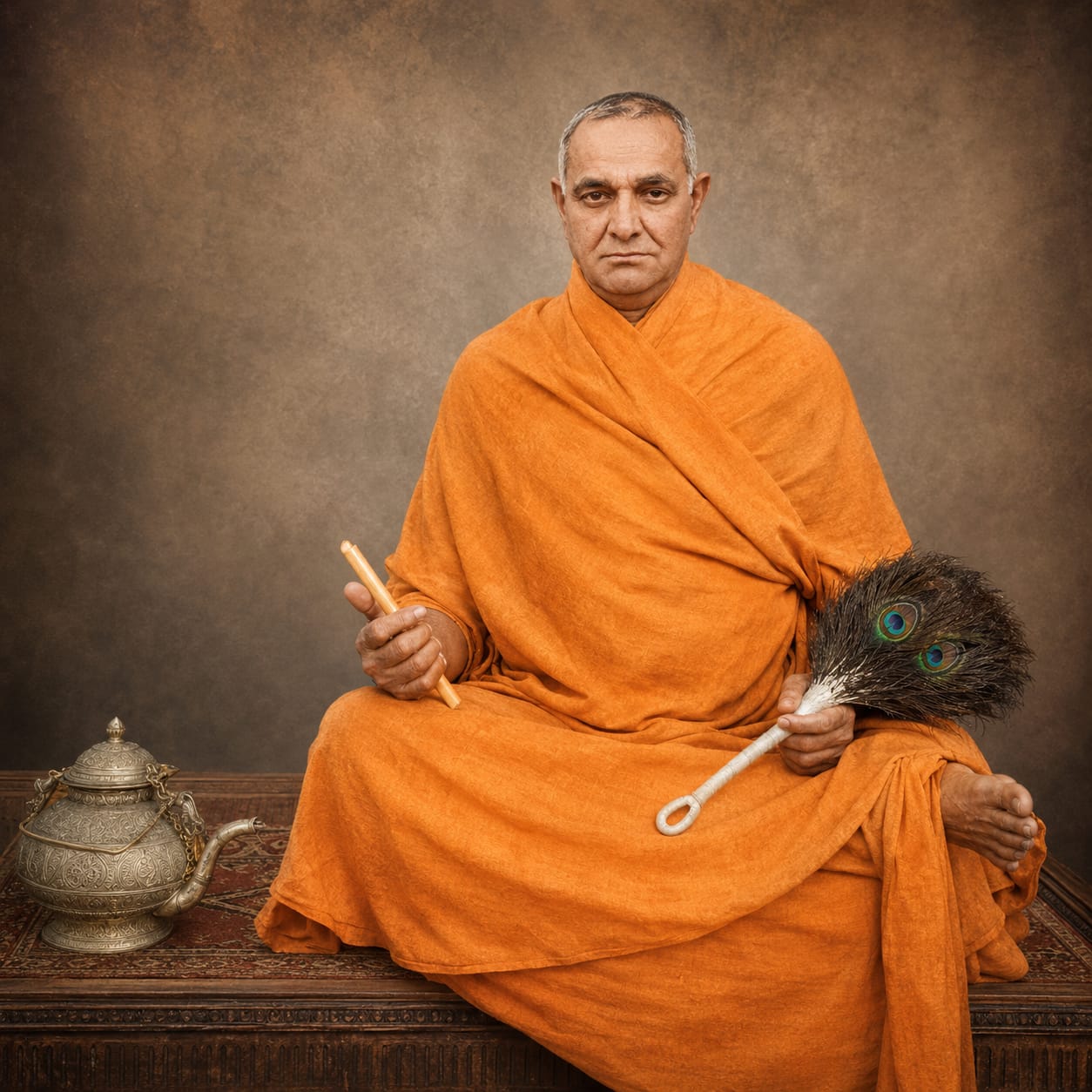
Image : Digambar Jain Bhattarak Yashkirti Ji
Sangh, gan, gachchh, anvay
One more thing you should know before we come to Kesariyaji, otherwise the inscriptions will not make much sense.
Bhattarak parampara is not one single line. It is a tree with many branches, and every lekh is very particular about telling you which branch. Three main sanghs are there.
• Mulsangh. It comes down through Kundkundacharyanvay, Saraswati Gachchh and Balatkargan. Names of Mulsangh bhattaraks mostly end with kirti, nandi or chandra.
• Kashthasangh. Acharya Devasen writes in Darshansar that Kumarsen, shishya of Acharya Vinaysen, established it at Nandiyad, which is today’s Nanded, in V.S. 753. Later it branched into Nanditat Gachchh, Mathur Gachchh, Bagad Gachchh, Ladbagad Gachchh and Punnat Gachchh. Anvays like Ramsenanvay and Lohacharyanvay also come in the lekhs. Their names mostly end with sen or bhushan.
• Mathur Sangh. Smaller one, but it was very much present, and it had its own seats and shastra vachan gaadis.
Why am I giving all this detail? Because every pratishtha lekh names the sangh, the gan, the gachchh and the anvay of the bhattarak who did the pratishtha. Which means the lekhs of a mandir are basically a signed and dated register of which parampara built it and consecrated it. It is not opinion. It is not claim. It is register.
What Dr Vidyadhar Johrapurkar writes about the Bhattaraks
Whenever somebody studies this subject seriously, one name comes first. Dr Vidyadhar Johrapurkar, and his book Bhattaraka Sampradaya. Most of the pattavalis and lekh numbers that gets quoted about Kesariyaji, including the ones in this article, finally go back to his work. So it is worth putting down what he himself says about the Bhattaraks as a whole. Whatever is written in this section are his views, from the introduction of that book.
How he defines a Bhattarak
According to him a Bhattarak is a particular type of Jain ascetic, and he is not the same thing as a muni or a yati. A Bhattarak took up the position of a religious ruler. He looked after the big estates that people had donated to temples, and in religious matters his authority was final. Johrapurkar compares the whole arrangement with the Shankaracharya tradition, which honestly is the easiest way to explain it to somebody who is hearing about it for the first time.
He also points out one thing which many people do not know. Bhattarak parampara is not only a Digambar thing. It is found in the Shwetambar sect also. But the seats which are known today are mostly Digambar.
How old is the tradition actually
This portion he has written very carefully, and honestly also, which I appreciate. The Dhavala, Harivamshapuran and other old texts agree about the line of acharyas for the first seven centuries after Bhagwan Mahavir, and Bhadrabahu the second and Loharya the second are the last two names in that line. Most bhattarak pattavalis start from one of these two. After that there is a gap. Proper historical references to these seats begin only from the eighth century, and even those are not continuous. The bhattarak paramparas as we know them today mostly begin from the thirteenth century onwards and continue till the present day. And about that gap of six centuries in between, Johrapurkar says plainly that the different traditions filled it up by claiming famous names like Kundkund, Samantabhadra, Devanandi Pujyapad and so on, each according to their own preference.
What they wrote
That one volume alone refers to about 400 compositions by various Bhattaraks. He divides this literature into three kinds. Epics, stories, and texts meant for worship. The epics and stories are mostly shorter versions of what is already there in Ravisen’s Padmapuran, Jinasen’s Harivamshapuran and the Mahapuran of Jinasen and Gunabhadra. And these are not only in Sanskrit and Prakrit. Apabhramsha, Hindi, Marathi, Gujarati and Rajasthani, all are there. He specially mentions the puranas of Sakalkirti of Ider and the many vratkathas of Srutasagarsuri. Apart from religious works, books on vyakaran, jyotish, chhand, nyaya, metaphysics, vaidyak and ganit are also found.
Pratishtha was considered their main work
This point of his matters a lot for Kesariyaji. He writes that installation of images was considered to be the main work of a Bhattarak. And these ceremonies were the big social occasion of that time also, a chance for a large religious gathering and a chance for a family to establish its standing in society. Titles like Sanghapati and Seth were conferred on the chief donor of the ceremony. If you look at the Kesariyaji lekhs with this in mind, the whole thing makes much more sense. That is exactly why the donor family, their jati, their gotra and their village are written in such detail.
One example he gives is really remarkable. At Mudasa in Rajasthan, Bhattarak Jinachandra installed more than one thousand images in a single ceremony, and the chief donor was Seth Jivaraj Papadiwal. This was on Akshaya Tritiya of Samvat 1548, that is 1492 AD. Those images were afterwards sent out to a large number of temples all over India, and today they are found from Amritsar to Madras and from Girnar to Calcutta. About twenty types of images were being installed in this age and the largest number were of Bhagwan Parshvanath, the twentythird Tirthankar. Temples, pillars and other monuments were also a big part of their work.
Manuscripts and teaching
Johrapurkar calls preservation of manuscripts the most valuable work done in this whole age, and I would agree with him fully. Old Jain works on grammar, medicine, mathematics and similar technical subjects were regularly studied by the shishyas of every learned Bhattarak, and several copies were prepared only for this purpose. There is one custom he mentions which I liked very much. The udyapan of a vrat usually meant donating some manuscript to a Bhattarak. So every vrat that a shravak completed used to add one more granth to the bhandar..
Society, castes and yatras
By their position as religious teachers the Bhattaraks were above caste distinctions, he says. But the influence of the surrounding society was so strong that it could not be ignored, and in practice every seat became associated with one particular caste.
They used to arrange long pilgrimages with big groups of followers. Srutasagar Suri’s visit to Gajapantha, and the various yatras of Devendrakirti the third of Karanja, he mentions as noteworthy. And they looked after the management of holy places also. The example he gives is Shri Mahavirji, which was managed by the Bhattaraks of Jaipur. Kesariyaji is exactly the same pattern, only with two gaddis instead of one.
Non Jain students also came to learn from them many times. He names Pt. Haji, Shaiva Madhava, Bhupati Prajna Mishra and Dvija Vishvanatha. The mathas of the Bhattaraks were centres of various social functions, and because of that music, painting, sculpture, dance and other arts also got preserved. People believed that Bhattaraks had miraculous powers obtained through mantras. Walking through air, removing the effect of poison, making a stone image speak, such miracles are ascribed to various of them.
What he concludes
The numbers he gives at the end tell you how big this subject really is. That one book alone carries references to some 400 Bhattaraks, 175 of their shishyas, 809 literary compositions, 90 temples, 81 castes, 100 rulers and 200 places. And he adds that if more sources are used, these figures can easily be doubled.
His last paragraph is worth remembering. He accepts frankly that the age, as it was, was not a very glorious one. But he says Jain history will remain incomplete without the mention of Sakalkirti, Shubhachandra and Jinachandra. A history of rise gives inspiration, a history of downfall gives lessons, and a growing society needs both of these. He also felt that this whole subject had been completely neglected till his time, and he hoped it would now get proper attention.
Why the Bhattaraks were so important
1. They kept Digambar dharma alive when there were no munis
Between roughly the 14th and the 19th century there were long long stretches when hardly any digambar muni was visible in north and west India. Muni diksha almost stopped. It came back properly only in the 20th century, with Acharya Shantisagar ji Maharaj. So what was happening in those three, four hundred years in between? The Bhattarak parampara was happening. If they had not been there, the chain of pratishtha would have broken somewhere, the tirths would have gone out of our hands, and there would be no organised samaj left to hand everything back to the munis when the munis finally returned..
2. They saved our literature
The shastra bhandars were built and maintained by them. Those huge collections of tadpatra and paper manuscripts carried the Jain agam, darshan, katha and puja sahitya through centuries when nothing else was carrying it. And the Bhattaraks were not only keepers, they were writers also. Bhattarak Sakalkirti, who started the Idar shakha, wrote Adipuran, Shantinath Charitra, Mulachar Pradip and many more. Bhattarak Shubhachandra, Gyanbhushan, Lalitkirti and others wrote a lot in Sanskrit, Prakrit, Apabhramsha and in the local languages.
3. They did the pratishthas, and this is the point that matters most
Pratishtha of a pratima, a yantra or a paduka is the adhikar of a Bhattarak. And a pratishtha always got recorded. The murtilekh will give you the name of the bhattarak who did it, his sangh and gan and gachchh and anvay, the donor family, their jati and gotra, where they lived, and the exact tithi and samvat. In the whole history of Indian temples you will not easily find evidence of this quality. Dated, signed, sampraday is clearly mentioned, and it is carved on the object itself so nobody can quietly change it later.
4. They ran the administration
Mandir property and its income, appointment of pujaris, disputes inside the samaj, vrats and their udyapans, representing the samaj in front of rulers and courts. All this was handled from the gaddi.
5. They held the samaj together
Jati sanghs, panchayats, gurukuls, chaityalays, dharmshalas, all of these grew around bhattarak gaddis. The gaddi was the address of the samaj. Any shravak with a question about vidhi vidhan, about inheritance, about a family dispute, or just a doubt, he went there.
Now, the Bhattaraks of Kesariyaji
At Rishabhdev Kesariyaji, total 7 to 8 shilalekhs are available and more than 50 murtilekhs. By number that is not a big archive. But by quality it is remarkable, every single one of these lekhs which names a religious authority names a Digambar Jain Bhattarak, there is not one exception in the whole record.
And here is a detail that most visitors never notice. The mandir was actually divided between two bhattarak gaddis.
The northern jinalays, that side had the gaadi of the Mulsanghi bhattaraks. The southern side was with the Kashthasanghi bhattaraks, and there they had their own gaadi and their own chaityalay, plus a kothri where the mandir ka saman used to be kept. That chaityalay was a portable one, whenever the Bhattarak went on pravas he used to carry it with him. Then in the south part of the Sabha Mandap there was a third gaadi. This one was the shastra vachan gaadi of the Mathursanghi Digambar Jain bhattaraks. In Vikram Samvat 1969 one officer of that time got it changed in a single night, on the excuse of repair work, and got Shri Madbhagavat written on it.
Kashthasangh, Nanditat Gachchh, Vidyagan, Ramsenanvay
The oldest lekh available at Kesariyaji is of V.S. 1431, that is 1374 AD, and it records the jirnoddhar of the main mandir done from the updesh of Kashthasanghi Bhattarak Dharmakirti. From that point onwards the Kashthasangh presence is continuous here, and their lekhs go till V.S. 1846.
The introduction formula in these lekhs is very fixed. Kashthasangh, Nanditat Gachchh, Vidyagan, Ramsenanvay. In one murtilekh Lohacharyanvay is given instead. And the V.S. 1753 shilalekh mentions Ladbagad Gachchh also, along with the amnay of Bhattarak Pratapkirti.
Names of this parampara found in the mandir lekhs include Ramsen, Dharmakirti, Yashkirti, Vishwabhushan, Tribhuvankirti, Bhimsen, Gopsen, Rajkirti, Lakshmisen, Indrabhushan, Surendrakirti, Pratapkirti, Shribhushan, Shubhachandra, Jaykirti, Sumatikirti, Devendrakirti and Gyankirti. Their pattavali runs like this. Ratnakirti, then Lakshmisen, then Bhimsen, then Somkirti (V.S. 1526 to 1540), then Vijaysen, Yashkirti, Udaysen, Tribhuvankirti, Ratnabhushan (V.S. 1674), Jaykirti (V.S. 1686), Keshavsen and Vishwakirti (V.S. 1696 to 1700). A parallel branch goes through Dharmasen, Vimalsen, Vishalkirti, Vishwasen (V.S. 1596), Vidyabhushan (V.S. 1604 to 1636), Shribhushan (V.S. 1634 to 1676), Chandrakirti (V.S. 1654 to 1681), Rajkirti, Lakshmisen (V.S. 1696 to 1703), Indrabhushan (V.S. 1715 to 1736) and Surendrakirti (V.S. 1744 to 1773).
One thing should be said honestly here. This table is not complete and the dating is also not fully settled. Several names which appear in the Kesariyaji lekhs, like Dharmakirti, Vishwabhushan, Gopsen, Pratapkirti, Shubhachandra, Sumatikirti and Gyankirti, are missing from the standard published pattavali. So there is still work left for scholars on this.
Mulsangh, Balatkargan, Idar shakha
The Idar branch of Balatkargan was started by Bhattarak Sakalkirti, V.S. 1450 to 1510, who was a shishya of Bhattarak Padmanandi. Three main shishyas of Padmanandi started three paramparas. Shubhachandra started the Delhi Jaipur shakha, Sakalkirti started the Idar shakha, and Devendrakirti started the Surat shakha.
Since the vyavastha of Rishabhdev kshetra was in the hands of the Idar shakha bhattaraks, they established one of their gaddis right here in the kshetra itself, so that managing it becomes easier. Mulsangh murtilekhs at Kesariyaji are found from V.S. 1611 to V.S. 1863. They did pratishtha of many pratimas here in V.S. 1611, 1711, 1742, 1746, 1766, 1767, 1768, 1773 and 1863.
This is the Idar shakha pattavali as it comes in the mandir records.
Bhattarak
Period
1. Sakalkirti
V.S. 1450 to 1510
2. Bhuvankirti
V.S. 1508 to 1527
3. Gyanbhushan
V.S. 1534 to 1560
4. Vijaykirti
V.S. 1557 to 1568
5. Shubhachandra
V.S. 1573 to 1613
6. Sumatikirti
V.S. 1622 to 1625
7. Gunakirti
V.S. 1631 to 1639
8. Vadibhushan
V.S. 1652 to 1656
9. Ramkirti
V.S. 1657 to 1670
10. Padmanandi
V.S. 1683 to 1702
11. Devendrakirti
V.S. 1713 to 1725
12. Kshemakirti
V.S. 1734
13. Narendrakirti
V.S. 1762
14. Vijaykirti
date not given
15. Nemichandra
date not given
16. Chandrakirti
V.S. 1832
17. Ramkirti
date not given
18. Yashkirti
V.S. 1863
Five hundred years, work by work
Below is the main construction and pratishtha work at Kesariyaji, taken from the mandir’s own shilalekhs and murtilekhs.
Vikram Samvat
AD
What was done at Kesariyaji
Bhattarak and Sangh
V.S. 1431
1374 AD
Jirnoddhar of the garbhagriha shikhar and Khela Mandap. Shah Hardas, his wife Haru and sons Puja and Kota paid for it. The lekh opens with the first shlok of the Digambar Svayambhu Stotra.
Bh. Dharmakirti, Kashthasangh
V.S. 1572
1515 AD
Nauchowki and Sabha Mandap constructed at Dhulev village by the Phadiya family, Kashyap gotra. Even the cost of construction is written in the lekh.
Bh. Yashkirti, Kashthasangh
V.S. 1611 to 1863
1554 to 1806 AD
The 52 jinalays around the main mandir, built and consecrated slowly over many generations.
Bh. Sakalkirti, Kshemakirti, Narendrakirti, Bhimsen, Gopsen, Devendrakirti, Surendrakirti, Lakshmisen, Gyankirti, Yashkirti
V.S. 1686
1629 AD
Kalash and dhwajadand raised on the nij mandir.
Bh. Rajkirti, Kashthasangh, Nanditat Gachchh
V.S. 1711
1654 AD
Lekh on the stone elephant standing in front of the main mandir. It names Mulsangh, Saraswati Gachchh, Balatkargan and Kundkund Swami.
Mulsangh, Balatkargan
V.S. 1734
1677 AD
Pratishtha mahotsav at Rishabhdev mandir. Pratima numbers 5, 10 (Rishabh jinbimb), 11 (Vasupujya jinbimb) and 35 in the devkulikas were consecrated at this time.
Bh. Bhimsen with Acharya Gopsen, Kashthasangh
V.S. 1742
1685 AD
Pratishtha of the Sahastrakut Chaityalay with its 1008 jin pratimas. This form is found only in Digambar tradition.
Bh. Nemichandra, Mulsangh
V.S. 1746
1689 AD
Pratishtha of a Parshvanath pratima.
Bh. Premkirti, Mulsangh
V.S. 1753
1696 AD
A 17 line inscription in Devnagari lipi and Sanskrit, near the devkulikas on the south side. Sanghvi Aalha of Bagherwal jati, Goval gotra, did a full pratishtha mahotsav here along with his whole family.
Bh. Surendrakirti, in the amnay of Bh. Pratapkirti. Kashthasangh, Nanditat Gachchh, Vidyagan, Ramsenanvay
V.S. 1754
1697 AD
Lekh number 4 of the southern devkulikas. Sanghvi Harbai of Humad Dasa lineage got three small prasads made.
Bh. Surendrakirti, Kashthasangh, Nanditat Gachchh
V.S. 1773
1716 AD
Bimb Pratishtha Maha Mahotsav. This is one of the five big occasions which even the Dhwajadand Commission later accepted.
Digambar bhattarak parampara
V.S. 1801
1744 AD
Pratishtha of the shyamvarn padmasan Parshvanath pratima in the outer parikrama, south side.
Digambar bhattarak parampara
V.S. 1832
1775 AD
Chaturvinshati Jin Paduka installed. It is still there today, on the right side in front of Marudevi Mata’s hathi. The full pattavali is carved on it. Sakalkirti, then Bhuvankirti, then Kshemakirti, then Narendrakirti, then Vijaykirti, then Nemichandra, then Chandrakirti.
Bh. Chandrakirti, Mulsangh, Saraswati Gachchh, Balatkargan, Kundkundacharyanvay (Idar shakha)
V.S. 1863
1806 AD
The parkota was built by Gandhi Vijaychand, Humad jati, Kamleshwar gotra, from Sagwara. Lekh number 5 about this is still fixed in the parkota wall.
Bh. Yashkirti, shishya of Bh. Chandrakirti, Mulsangh
The 52 jinalays
The bawan jinalays around the main mandir, which represent the 52 jinalays of Nandishwar Dvip, were not made in one go. They came up slowly between V.S. 1611 and V.S. 1863. And the pratishtha of the tirthankar pratimas inside them was done by Bh. Sakalkirti, Bh. Kshemakirti, Bh. Narendrakirti, Bh. Bhimsen, Bh. Gopsen, Bh. Devendrakirti, Bh. Surendrakirti, Bh. Lakshmisen, Bh. Gyankirti and Bh. Yashkirti. Every one of them a Digambar Bhattarak. And every pratishtha carved on the pratima itself.
What all this actually proves
Pratishtha is a sampradayik act and its record stays permanently on the object. That is why the bhattarak lekhs at Kesariyaji are not an argument about the tradition of this mandir. They are the documentation of it. The people who gave the updesh for construction and the people who performed the pratishtha, that is the pratishthacharya and the pratishthakarak both, were Digambar Jain in each and every available lekh. And this fits with everything else you can see there. The Sahastrakut Jinalay. The sixteen sapnas of Marudevi Mata in the parikar of the mulnayak, because Shwetambar tradition counts fourteen. The khadgasan pratimas carved all over the outer walls.
This is also why the historical record carried weight in the disputes of the twentieth century. The Dhwajadand Commission accepted that Digambars had done pratishtha here on five big occasions, in V.S. 1431, 1572, 1753, 1773 and 1863. The commission submitted its report on 10 April 1935. It was published on 5 June 1947 and it said that this is originally a Digambar Jain mandir. Later, under pressure, a revised order was issued and the word Digambar was removed from it. The Supreme Court, in its orders of 14 September 1973, 4 July 2007 and 26 July 2010, declared the Rishabhdev mandir a Jain mandir and directed that its management should be handed over to the Jain community. At present the vyavastha is still with the Devasthan Vibhag of the Rajasthan government.
What you can still go and see
The Bhattaraks are not only a chapter from the past. Their footprint is still standing in and around Rishabhdev town.
• Bhattarak Bhavan, also called Saraswati Bhavan. A grand five storey building with a chaityalay in Holi Chowk, about 200 metres from the mandir. Very old Jain sahitya and agam granths on tadpatra are kept in the Saraswati Bhavan.
• Bhattarak Yashkirti Digambar Jain Gurukul. On the Pagliyaji road, off Hospital Road. It was established in 1968 and earlier students from outside the kshetra used to stay here and study. The Adinath mandir in the campus had its panchkalyanak pratishtha on 25 May 1975, and today there is a well equipped Digambar Jain dharmshala in the same premises.
• Bhattarak Bhimsen Smarak, known as Bhim Paglya. The old smarak of the Kashthasangh bhattarak, near Krishna Ghat darwaja, roughly 500 metres from the mandir.
• The Kashthasanghi gaadi and chaityalay. Still there in the southern jinalays, the same seat from where the Bhattarak used to do shastra vachan for the samaj.
• The Chaturvinshati Jin Paduka of V.S. 1832. Installed by Bhattarak Chandrakirti and still lying on the right side in front of Marudevi Mata’s hathi.
Last thought
It is very easy to think of a tirth as just a building. Kesariyaji is better understood as five hundred years of steady institutional work. A chain of saffron robed pithadhish, one after another, each one inheriting a mandir, adding something to it, doing the pratishtha of whatever he added, getting a lekh carved about it, and then handing it forward.
Next time you go for darshan, stand in front of that Chaturvinshati Jin Paduka near Marudevi Mata’s hathi and just read the names carved on it. Seven generations of bhattaraks on one small stone. That, more than anything else, is the real record of Kesariyaji.
Sources: shilalekhs and murtilekhs of the Rishabhdev Kesariyaji mandir; Prachin Tirth Jirnoddhar (Kesariyaji Visheshank), March 2007; Jain Tirthvandana, February 2010; Shri Rishabhdev Mandir evam Iski Parampara, Sankshipt Itihas. The section on the Bhattarak tradition in general is based on the views of Dr Vidyadhar Johrapurkar in his book Bhattaraka Sampradaya, from the introduction which is a digest of the Hindi prastavana.