
29 April 2026 · Admin
Is Kesariyaji a Digambar or Shwetambar Temple? The Complete Evidence
"Kesariyaji Digambar ka hai ya Shwetambar ka?" — You have heard this question many times. The confusion is real, but the evidence is not. Here is the complete picture.
Why Does This Question Even Exist?
If you search "Is Kesariyaji Digambar or Shwetambar," you will find contradictory answers. Some websites say it is a Shwetambar temple. Some say it is disputed. Some say it belongs to both communities. Wikipedia leads with a 1966 Rajasthan High Court judgment that characterised it as Shwetambar. Travel blogs casually list it under both communities without explaining anything.
This confusion has a specific historical cause — and it is worth understanding clearly before examining the evidence.
For most of its 1,200-year history, Kesariyaji was managed entirely by Digambar Jain Bhattarakas and Digambar Jain shravak communities. In the late 18th and 19th centuries, the Mewar state came under increasing Shwetambar influence. Shwetambar community members were appointed to key positions in the Mewar Devasthan Vibhag. Through this political leverage — not through historical ownership — Shwetambar presence in the temple's administration grew. This political history is what created the confusion that exists today.
The evidence — inscriptional, architectural, iconographic, and legal — tells a clear story. Let us go through it systematically.
What the Temple Itself Says — The Architecture and Iconography
Before examining any court judgment or historical record, look at the temple itself. Every physical element of Kesariyaji speaks unambiguously about its tradition.
The Mulnayak Idol
The garbhagriha enshrines the mulnayak Lord Adinath (Rishabhdev) in padmasana mudra — a 3.5-foot Krishna-stone idol under three chhatras, with an ashta-dhatu parikara featuring khadgasana Digambar Tirthankaras, musician ensembles, and celestial abhisheka motifs.
The idol is completely naked — in the Digambar Jain tradition of nagna veetaragi posture. This is not incidental. Digambar Jainism holds that a fully liberated Tirthankara is clothed in nothing but the sky — digambar literally means "sky-clad." Shwetambar iconography clothes Tirthankaras in white robes. The Kesariyaji mulnayak idol is naked. It is a Digambar idol.
The 16 Dreams of Marudevi
On the platform beneath the mulnayak idol are carved the 16 dreams seen by Mata Marudevi before the birth of Lord Rishabhdev. This is definitive. Digambar tradition records 16 dreams. Shwetambar tradition records only 14. An idol installed in the Shwetambar tradition would show 14 dreams — not 16. This single detail, carved permanently into the stone platform, proves the idol was created, installed, and worshipped in the Digambar tradition.

Image : Mata Marudevi's 16 dreams encarved in Garbhgrah of Kesariyaji Rishabhdev
Chakreshvari and Padmavati Yaksha-Yakshinis
The rear panel depicts Marudevi's sixteen dreams as per Digambar tradition. The entrance to the temple also features Padmavati and Chakreshvari — the shasan-devis (attendant goddesses) of Rishabhdev according to Digambar Jain shastras (Pratishtha Sara Sangrah, Pratishtha Sara Rodhara, Pratishtha Tilakam). Their iconographic depiction here — four-handed Chakreshvari holding chakra, positioned on the Lalatabishb — matches Digambar scriptural description, not Shwetambar.

Image : Chakreshvari and Padmavati Yaksha-Yakshinis in Garbhgrah of Kesariyaji Rishabhdev
The Panch Balyati Bhagwan Idols in the Khela Mandap
On both sides of the Khela Mandap — the outer congregation hall leading to the garbhagriha — are installed idols of the Panch Balyati Bhagwan (the five Tirthankaras who were Baal Brahmacharis).
This is a theological point that cuts to the heart of the Digambar vs Shwetambar question. Panch Balyati refers to five specific Tirthankaras whom Digambar Jain tradition identifies as having been lifelong celibates — Baal Brahmacharins who never married. These are Vasupujya, Malllinath, Neminath, Parshvanath, and Mahavir Swami. Digambar Jainism holds that these five Tirthankaras were Baal Brahmachari — they never married. This belief is unique to Digambar tradition.
Shwetambar Jainism holds a fundamentally different position — that all 24 Tirthankaras were married before taking diksha. In Shwetambar tradition, the concept of Panch Balyati itself does not exist in the same form.

Image : Panch Balyati Bhagwan Pratima at Kesariyaji Rishabhdev
Now consider this: the Khela Mandap at Kesariyaji has Panch Balyati Bhagwan idols installed on both sides. If this were a Shwetambar temple — if it had ever been designed, built, or managed with Shwetambar theology in mind — why would it specifically install idols that represent a concept unique to Digambar theology? A Shwetambar institution would have no reason to install Panch Balyati idols. Their very presence in the Khela Mandap is a silent, permanent declaration of this temple's Digambar identity.
No Chaksu Has Ever Been Installed at Kesariyaji
The mulnayak idol at Kesariyaji — the 3.5-foot black stone Rishabhdev — has never had Chaksu (artificial eyes) installed on it. This has been the case throughout the temple's history.
This is significant because installing Chaksu (painted or jewelled eyes) on a Tirthankara idol is a Shwetambar practice. In Shwetambar tradition, Tirthankara idols are decorated with ornaments, clothing, and Chaksu as part of their puja customs. In Digambar tradition, a Tirthankara idol is worshipped in its natural, unadorned form — nagna (naked), without ornaments, without Chaksu.
The fact that no Chaksu has ever been part of the established puja tradition at Kesariyaji is direct evidence of Digambar management. Had this been a Shwetambar temple, there would be a long, documented history of Chaksu installation — it would be a regular feature of the puja. Instead, the one famous attempt to install Chaksu on the idol — along with mukat (crown) and kundal (earrings) — was made by Shwetambar officials on 4 May 1921, without Maharana's permission, using military force. It resulted in four Digambars being killed inside the temple premises. That single violent attempt — far from establishing a Shwetambar tradition — became the most damning proof that Chaksu had never belonged here and that the Digambar community was willing to die to preserve the idol's Digambar form.
The Sahasrakuta Jinalaya and 52 Jinalayas
The complex includes a Sahasrakuta Jinalaya with 1,008 idols — a feature distinctive to the Digambar Jain tradition. The 52 outer Jinalayas are inspired by the concept of Nandishwar Dvipa's 52 islands.
Here is a detail that directly distinguishes Digambar from Shwetambar: a Digambar Sahasrakuta Jinalaya has 1,008 pratimas, while a Shwetambar Sahasrakuta Jinalaya has 1,024 pratimas. The Kesariyaji Sahasrakuta Jinalaya has 1,008 — the Digambar count. This is not coincidence. It is a deliberate construction following Digambar tradition. The 52 outer Jinalayas, built between VS 1611 (1554 CE) and VS 1863 (1806 CE), were all constructed and consecrated by Digambar Bhattarakas — as documented by their own inscriptions, discussed below.
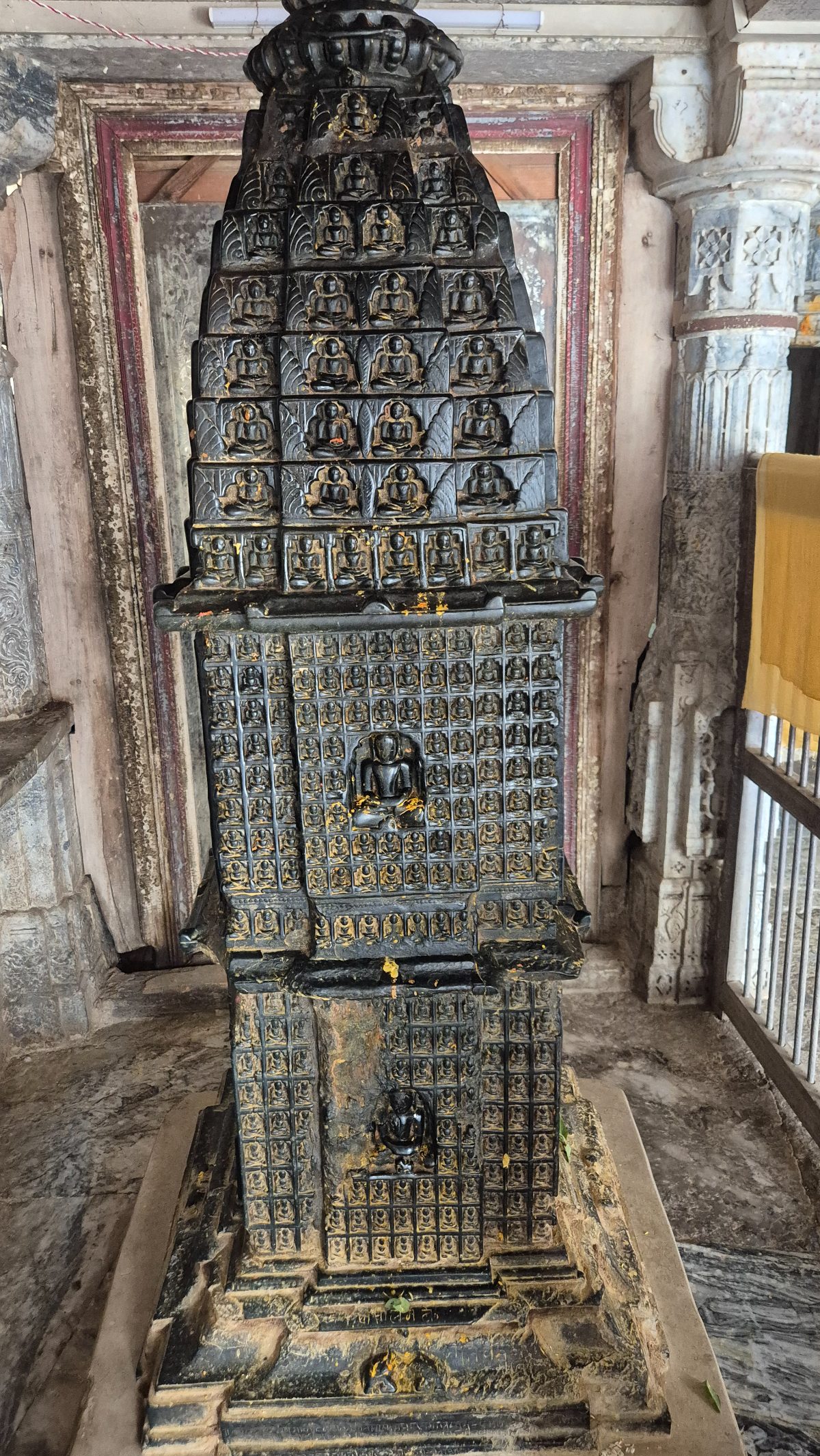
Image : Sahastrakut Jinalaya with 1008 Digambar idols at Kesariyaji Rishabhdev Temple
What the Inscriptions Say — Stone Does Not Lie
Kesariyaji has five major historical inscriptions on its walls. Every single one names a Digambar Jain Bhattaraka as the supervising authority. Not one Shwetambar Acharya, not one Shwetambar institution, is named in any inscription.
Inscription 1 — VS 1431 (1374 CE) — The Most Important
This is the oldest and most significant inscription. It is carved on the north wall of the Khela Mandap and has been there for over 650 years.
In Vikram Samvat 1431 (1374 CE), under the guidance of Digambar Jain Kashtasangh Bhattaraka Shri Dharmakirti ji, Shah Hardas and his sons renovated the garbhagriha shikhara and Khela Mandap of Kesariyaji temple, confirming an earlier Digambar temple existed under Digambar monastic leadership.

Image : The Vikram Samvat 1431 Inscription at Kesariyaji Rishabhdev Temple
The inscription opens with the first verse of the Laghu Svayambhustrot — a Digambar Jain Sanskrit composition praising Lord Adinath. A Shwetambar community would have chosen a verse from their own scriptural canon. The inscription's renovator chose a Digambar composition.
Most critically — what was renovated? The garbhagriha shikhara — the spire above the innermost sanctum. You do not hand over the keys to your most sacred inner sanctum to someone from another sect. The fact that a Digambar Bhattaraka supervised this renovation in 1374 CE proves the temple fundamentally belonged to the Digambar tradition at that time.
What is a Bhattaraka? A Bhattaraka is the head of a Digambar Jain monastic institution. This institution is exclusively Digambar — it does not exist in Shwetambar Jainism. When a Bhattaraka supervised Kesariyaji's garbhagriha renovation, it means a Digambar institutional head had full authority over this temple's innermost space.
Scholar Vidyadhar Joharapurkar documented this inscription in his authoritative Bhattarak Sampraday (1958, p.259-62) and confirmed it as a Digambar tradition record.
Inscriptions 2–5 — An Unbroken Digambar Chain
The chain continues without a single gap:
VS 1572 (1515 CE): Nau-Chouki and Sabha Mandap constructed under Kashtasangh Bhattaraka's guidance by Jain shravaks of Dhulev village.
VS 1611 (1554 CE): Multiple idols installed in the Khela Mandap by Moolsangh Bhattaraka Shri Shubhchandra. Each idol has an inscription confirming Moolsangh (Digambar) installation.
VS 1753 (1696 CE): Construction under Kashtasangh Nanditat Gaccha Bhattaraka Surendrakeerti, naming the sequence of preceding Bhattarakas in the lineage.
VS 1863 (1806 CE): Outer Perkota (enclosure wall) constructed under Balaatkar Gana Bhattaraka Yashkeerti, listing all preceding Bhattarakas — Ramkeerti, Chandrakeerti, Nemi Chandra, Vijaykeerti, Narendrakeerti, Kshemakeerti, Devendra Keerti, Padmanandi, Vadibhushan, Gunakeerti.
A total of 18 Digambar Bhattarakas presided over Kesariyaji from VS 1450 to VS 1863 — a span of over 400 years of continuous, documented Digambar institutional management. Every family name in these inscriptions belongs to communities of Digambar tradition.
This is not a claim. It is what the temple walls say.
What the Dhwajadand Commission Found
In 1921, Shwetambar officials — using their positions in the Mewar state administration — attempted to place ornaments (mukat, kundal, chakshu) on the naked Digambar idol and hoist a flag on the temple shikhara, without Maharana's knowledge or permission. When thousands of Digambars protested, troops were called. Four Digambars were killed inside the temple premises. 150 were injured.
The Mewar government constituted a commission of inquiry. That commission submitted its report in 1935. The original report stated clearly that Kesariyaji is "moolatan Digambar Jain mandir" — fundamentally a Digambar Jain temple.
However, due to heavy Shwetambar political influence in the Mewar administration, when the report was published in 1947, the word "Digambar" had been deleted. The published version said "Jain temple" — technically true, but stripped of the specific sectarian identity the commission had established.
This suppression is documented in Keshariya Hatyakand by Shri Vadilal Motilal Shah — notably, a Shwetambar Sthanakvasi author who investigated the events as a neutral witness with no personal stake in the Digambar-Shwetambar dispute. His testimony carries exceptional credibility precisely because he was not Digambar. He concluded, based on his independent investigation, that the evidence overwhelmingly supported Digambar ownership.
What About the Shwetambar Claims?
It would not be fair to present only one side. Here are the main arguments made by those who claim the temple has Shwetambar association — and what the evidence actually shows.
Claim 1: The 1966 Rajasthan High Court Declared It Shwetambar
What actually happened — and what the Shwetambars did very cleverly: When the Shwetambar community filed the case before the Rajasthan High Court in 1966, they deliberately did not make the Digambar Jain community a party to the case. This was not an oversight — it was a calculated legal strategy. By keeping Digambars out of the case entirely, there was no opposing party to present the Digambar historical evidence — the inscriptions, the Bhattaraka lineage, the iconographic proof — before the court. Naturally, hearing only one side, the HC ruled in the Shwetambar community's favour.
When the Digambar Jain community learned of this judgment, they appealed to the Supreme Court of India. The Supreme Court, hearing both sides, overruled the High Court's decision. The Supreme Court declared it a "Jain temple" in judgments of September 14, 1973, January 4, 2007, and July 26, 2010 — and directed that management and control be handed to the Jain community, with the State directed to resolve the ongoing disputes between Digambar and Shwetambar communities.
The Supreme Court overruled the High Court. Currently under Rajasthan Devasthan Vibhag management, Kesariyaji remains undisputedly a Digambar Jain Temple, as affirmed by the Supreme Court.
A High Court judgment won by keeping the opposing party out of court does not override 650 years of Digambar inscriptions on the temple walls.
Claim 2: Bhamashah (Shwetambar Minister) Donated to the Temple
Bhamashah, the famous minister to Maharana Pratap, was indeed Shwetambar and is said to have made donations toward the temple. But a donation does not constitute ownership. Digambar Jain institutions have donated to Shwetambar temples throughout history and vice versa. Donations reflect generosity and religious merit — they do not transfer religious identity.
Claim 3: Shwetambar Idols Are Present in the Temple Complex
This is true — some outer Jinalayas do contain Shwetambar idols. But consider this logically: the inscriptions on those very Jinalayas state that the pratishtha was performed by Digambar Bhattarakas. If the pratishtha inscription in a Jinalaya names a Digambar Bhattaraka, how did Shwetambar idols come to be placed there? The answer is that these Shwetambar idols were placed later — the inscriptions themselves confirm this, recording installation dates from the 17th century onwards, precisely when Shwetambar political influence in the Mewar court was at its peak.
There is an even more telling detail. Among the Shwetambar idols in the 52 Jinalayas, there is an idol of Vijay Suri Maharaj — a Shwetambar Acharya. Now consider the architecture of any Jinalaya — Digambar or Shwetambar — anywhere in India. A Jinalaya, by definition, enshrines only Tirthankara pratimas. It does not enshrine an Acharya's idol. No Digambar Jinalaya has an Acharya idol. No traditionally built Shwetambar Jinalaya has an Acharya idol either. The presence of Vijay Suri Maharaj's idol in a Jinalaya makes it immediately obvious that this idol was placed there later — as a deliberate act of occupation — and was never part of the temple's original design or tradition. The inscription itself confirms this idol was placed around the 18th century.
Dr. Navneet Kumar Jain's archaeological survey (Jain Tirth Vandana, February 2010) further notes that some of these Shwetambar idols were placed during and immediately after the Dhwajadand Hatyakand of 1921 — exploiting the disruption and Shwetambar administrative control at that time. These later additions in a few outer Jinalayas do not alter the fundamental Digambar character of the main temple, whose garbhagriha and primary structure are entirely Digambar.
What the Official Temple Website Says
Kesariyaji, or Rishabhdev, is a renowned Digambar Jain Atishay Kshetra located about 65 km south of Udaipur on NH-48. Historically managed by Kashtasangh and Mulasangh Digambar Bhattarakas, the temple withstood attempts by Shwetambaras empowered during Mewar state rule to convert this Digambar temple, despite some contested idols placed amid disputes.
The official Kesariyaji website — kesariyaji.org — identifies the tirth unambiguously as a Digambar Jain Atishaya Kshetra and documents the history of Digambar Bhattaraka management in detail, including photographs of the inscriptions.
The Daily Puja — Living Proof
The daily morning Pooja and Shantidhara are performed by the local Digambar Jain community on the Nau Chowki Vedi, which is located outside the Khelamandap.
The puja performed at Kesariyaji every single day follows the Digambar Jain Panch Kalyanank tradition — including Jal abhishek, Doodh abhishek, kesar-pushp arghya, and aarti performed according to Digambar puja paddhati. The daily Shantidhara, the Dashalakshan puja, the Janma Kalyanak celebration, the Rathyatra — all are organised and conducted by the local Digambar Jain samaj of Rishabhdev. This is not recent. This is an unbroken tradition.
As stated in the puja vidhi article by Shantilal Jain Jangda (Udaipur), a senior Digambar Jain scholar: "इस मंदिर में पूजा अर्चना हिन्दू रीति की नहीं होकर यह दिगम्बर जैन पद्धति की ही है। यहाँ की पूजा पद्धति के मूल तत्व दिगम्बर जैन परम्परा के ही हैं।" — "The puja at this temple is not Hindu puja — it is purely Digambar Jain puja. The fundamental elements of the puja paddhati here belong to the Digambar Jain tradition."
Conclusion: The Evidence Is Clear
The question "Is Kesariyaji Digambar or Shwetambar?" has a clear answer when you look at the actual evidence rather than political history.
The idol is Digambar. The inscriptions are Digambar. The architecture is Digambar. The puja tradition is Digambar. The Bhattaraka lineage is Digambar. A neutral Shwetambar investigator concluded it is Digambar. The Dhwajadand Commission originally said it is Digambar. The Supreme Court confirmed it is a Jain temple and directed management to the Jain community.
The Shwetambar association with Kesariyaji is a product of political circumstances in the 18th–20th centuries — specifically the influence Shwetambar community members gained through the Mewar court. This political history is real and should not be dismissed. But political influence in a given century does not transform a temple's foundational religious identity that has been documented in stone since 1374 CE.
Shri 1008 Rishabhdev Kesariyaji is, and has always been, a Digambar Jain Atishaya Kshetra.
For Digambar pilgrims planning a visit: the best time for Digambar swaroop darshan of the naked mulnayak idol is during the morning or afternoon abhishek — as this is the only time the idol can be seen in its pure Digambar form. For complete darshan timings, visit kesariyaji.org.
। जय आदिनाथ।
Frequently Asked Questions
Q: Is Kesariyaji a Digambar or Shwetambar temple? Based on inscriptional evidence dating to 1374 CE, archaeological analysis of the idol's iconography, the testimony of 18 documented Digambar Bhattarakas, and the daily puja tradition maintained by the local Digambar Jain community — Kesariyaji is a Digambar Jain Atishaya Kshetra.
Q: Why do some sources say Kesariyaji is Shwetambar? A 1966 Rajasthan High Court judgment characterised the temple as Shwetambar — but crucially, the Shwetambar community deliberately did not make the Digambar community a party to that case, so the court heard only one side. When Digambars appealed to the Supreme Court, the Supreme Court overruled the High Court's decision and declared it a Jain temple in 1973, 2007, and 2010.
Q: Can both Digambar and Shwetambar Jains visit Kesariyaji? Yes. The temple is open to all Jain pilgrims for darshan. The formal daily puja and abhishek ceremonies, however, are performed by the local Digambar Jain community following Digambar tradition.
Q: What is the significance of the 16 dreams at Kesariyaji? The 16 dreams of Mata Marudevi carved on the mulnayak platform are a direct architectural proof of the idol's Digambar identity. Digambar tradition records 16 dreams before Rishabhdev's birth. Shwetambar tradition records 14. The carving of 16 dreams establishes that this idol was created and installed in the Digambar tradition.
Q: How old is the Kesariyaji temple? The first shrine at this site dates to approximately the 2nd century CE. The stone structure was built in the 8th century CE. The oldest surviving inscription — on the Khela Mandap north wall — dates to 1374 CE and records a renovation of an already-existing Digambar temple.
Q: Where is Kesariyaji located and how do I reach it? Kesariyaji is located in Rishabhdev village, Udaipur district, Rajasthan — approximately 65 km south of Udaipur on NH-48. It is easily accessible by road from Udaipur. For darshan timings and complete visitor information, visit kesariyaji.org.
[Is Kesariyaji Shwetambar Or Digambar, Kesariyaji Shwetambar Tirth, Kesariyaji Tirth, Kesariyaji Digambar or Shwetambar, Kesariyaji Shwetambar or Digambar]